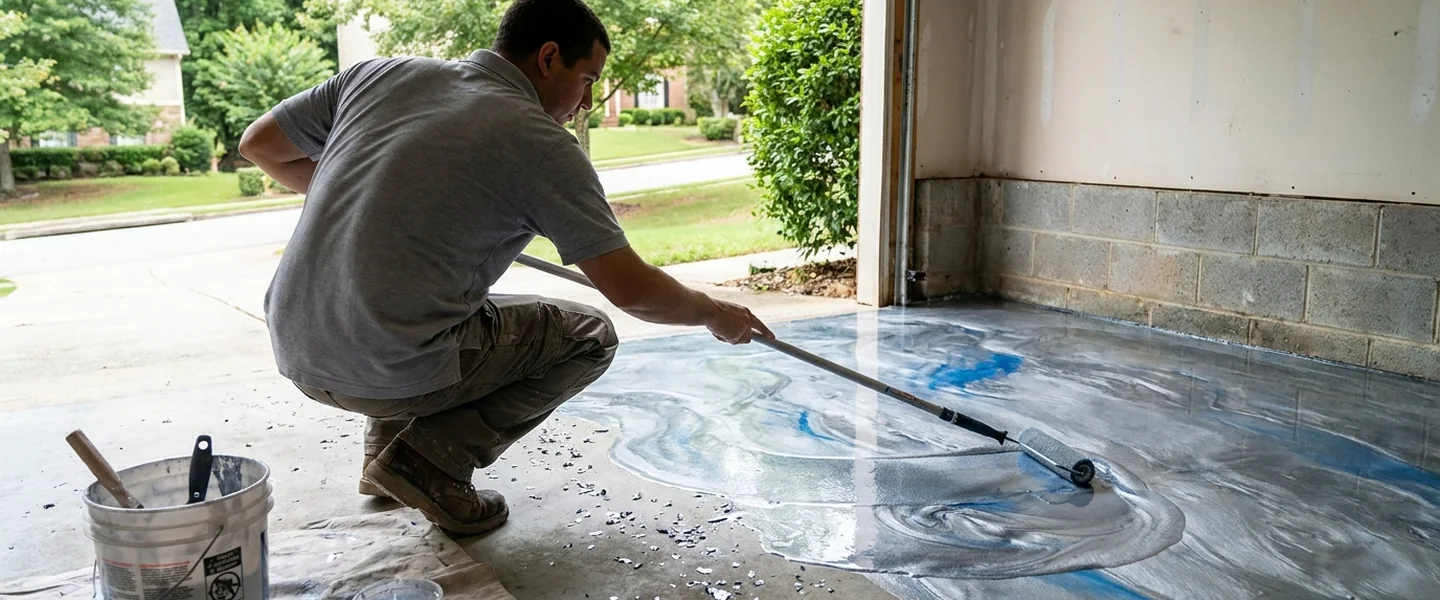
Concrete Floor Repair and Coating in Atlanta, GA
Crack fill, spall repair, and slab resurfacing — then coated in one mobilization. Atlanta concrete restoration before the epoxy goes down.
Call (470) 798-1247Most Atlanta garage and basement slabs have some combination of cracks, spalls, divots, or surface deterioration that needs to be addressed before a coating goes down. Some contractors skip this step — they apply coating over problem concrete and hope the damage is hidden. The result is a floor that looks fine for 60 days and then shows every underlying defect as the coating telegraphs the slab surface beneath it. We repair first, then coat — and we do both in one mobilization so you're not scheduling two separate visits for what should be a single project.
Why Atlanta Concrete Needs Repair Before Coating
Atlanta's concrete slabs show characteristic damage patterns driven by the region's geology and climate. Georgia red clay soils expand and contract seasonally with moisture content — creating movement cycles that crack slab concrete, particularly at control joints, perimeter edges, and mid-slab where differential settlement occurs. Atlanta's freeze-thaw cycles, though milder than northern cities, are sufficient to widen existing surface cracks through winter moisture intrusion and expansion. Summer slab temperatures exceeding 120°F under a closed garage door accelerate concrete surface deterioration and delamination of prior coatings that protect the aggregate.
In Marietta and Smyrna neighborhoods built in the 1960s–1980s, poured garage slabs commonly show aggregate pop-out and surface spalling from decades of tire traffic and occasional de-icer contact. In Alpharetta and Johns Creek new construction, slabs less than a year old may show plastic shrinkage cracks and honeycombing from rapid cure in Georgia summer heat. Each requires different repair materials and techniques before coating can proceed.
Project Details
| Repair Types | Cracks, spalls, divots, surface delamination, honeycombing, edge damage |
|---|---|
| Repair Materials | Semi-flexible polyurea (cracks), rigid epoxy mortar (structural spalls), polyaspartic skim coat (surface restoration) |
| Typical Timeline | 2–3 days (repair curing time before coating) |
| Coating Options | Full flake, solid color, metallic, polyaspartic — same as standard install |
| Warranty | 15-year product, 5-year workmanship — repair + coating covered as an integrated system |
| Pricing | Quoted per job after on-site assessment — every quote is itemized showing repair scope separately from coating scope |
Concrete Repair Types We Address
- 1Crack Repair — Cracks are chased (opened with a grinder to create a clean V-groove), cleaned of dust and debris, and filled with semi-flexible polyurea. Semi-flexible filler allows the repaired crack to move slightly with the slab's seasonal expansion and contraction without re-cracking — rigid fillers crack again at the repair site.
- 2Spall Repair — Spalled areas (where the surface concrete has broken away, exposing aggregate) are ground to a stable depth, cleaned, and filled with epoxy mortar or polymer-modified patching compound. The repair is built to flush with the surrounding slab surface before coating.
- 3Divot and Impact Damage Repair — Point-load impact damage from dropped tools or equipment is filled to flush. Small divots can be filled in the grinding pass; larger ones require mortared fill and a cure period before the coating application.
- 4Surface Delamination Repair — Failed prior coatings or delaminating concrete surface layers are ground away completely. A resurfacer or skim coat is applied if the aggregate is fully exposed over large areas and the surface profile requires leveling before the new coating system.
- 5Control Joint Repair or Fill — Control joints (the intentional cuts in slabs) can be filled for a seamless finish or left open with flexible caulk depending on the slab's movement history and the homeowner's preference. We'll advise which approach is appropriate for your specific slab.
- 6Coating Application — After all repairs have cured and the slab is diamond-ground to the correct profile, the coating system is applied — primer, base coat, flake or decorative layer, polyaspartic topcoat — exactly as with a new slab installation.
Common Concrete Repair Scenarios in Atlanta
1970s–1980s Marietta Garage Slabs
Aggregate pop-out, surface spalling, and mid-slab cracks from decades of traffic and Atlanta's seasonal clay movement. Comprehensive repair before coating — not cosmetic fill-and-cover.
New Alpharetta Construction Shrinkage Cracks
Plastic shrinkage cracks in slabs less than a year old. Semi-flexible filler allows the slab to continue its slow cure cycle without reopening the repair site. Coating is deferred until the slab moisture drops to coating-compatible levels.
Failed Prior Epoxy Removal
Peeling or delaminating prior epoxy coating ground completely away. If the old coating has pulled concrete surface with it, resurfacing compound is applied to restore the slab to a coatable profile before the new system goes down.
Impact Damage in Workshop Floors
Divots and chips from dropped equipment in garage workshops. Filled to flush, ground smooth, and coated as part of the standard two-day install. The repaired areas are not visible under the finished flake system.
Warranty in Detail
Concrete repair and coating completed in the same mobilization are warranted as an integrated system — the repair and the coating are both covered under our 15-year product warranty and 5-year workmanship warranty. The repair is not a separate lower-warranty item. What's not covered: new cracking that develops in areas outside the original repair scope due to ongoing slab movement or settlement events after installation. If your slab has significant structural movement, we'll note that in writing and discuss whether the coating project should wait until the underlying cause is addressed.
Concrete Repair and Coating FAQ — Atlanta
Can you coat over cracked concrete without repairing it first?
Technically yes — coating goes on whether or not the cracks are filled. But the cracks will telegraph through the coating within months as the slab continues its seasonal movement, creating visible lines in your floor and eventually moisture paths under the coating. We fill cracks before coating on every job — it's not an upsell, it's what produces a floor worth warranting.
What repair material do you use for cracks in Atlanta's clay soil areas?
Semi-flexible polyurea for moving cracks. Georgia's red clay creates seasonal slab movement — a rigid crack fill will simply crack again at the repair boundary when the slab moves. Semi-flexible filler moves with the slab within its rated range and stays intact through Atlanta's wet-dry clay cycle.
Can my Atlanta garage floor be repaired if it's badly spalled?
Yes, up to a point. Spalls — areas where concrete surface has broken away — are filled with epoxy mortar or resurfacing compound, ground flush, and coated. If the spalling is extremely deep or covers the majority of the slab, we may recommend a full resurfacing skim coat before the epoxy system. We'll tell you at the estimate what the slab condition realistically requires and give you honest guidance on whether repair-and-coat is the right approach or whether a different solution is needed.
How long do concrete repairs need to cure before coating?
Most polyurea crack fills are ready for coating in 30–60 minutes. Epoxy mortar spall repairs typically require 4–8 hours. Resurfacing skim coats require 24 hours before coating begins. For jobs with significant repair scope, Day 1 is repair and Day 2 is coating — which is why our timeline is 2–3 days for repair-and-coat projects.
Will the repaired cracks be visible after coating?
In a full flake broadcast system, repaired cracks are not visible in the finished floor — the flake pattern and the uniform surface completely conceal the repair boundary. In a solid-color system, a very slight texture difference may be detectable at the repair site under raking light. We'll tell you what to expect for your specific system choice at the estimate.
Should I repair control joints or fill them?
Control joints (the straight saw-cut lines in garage slabs) can be filled for a seamless appearance or left open with a flexible caulk. If your slab has shown significant movement at the control joints (one side higher than the other, or cracks adjacent to the joint), filling them is riskier — the movement will eventually re-open the fill. We'll assess the joint condition at the estimate and give you an honest recommendation rather than just filling everything for a quick sale.
Can you repair and coat an old Atlanta driveway or exterior concrete?
We focus on enclosed garage and basement floor applications. Exterior concrete — driveways, patios, pool decks — requires UV-stable and weather-resistant coating systems designed for outdoor exposure and freeze-thaw cycling. Call us to discuss your specific project and we'll let you know if it's within our scope.
Do you repair concrete in commercial facilities in Atlanta?
Yes. Commercial concrete repair before coating is part of our commercial epoxy flooring service. Old warehouse slabs, auto shop floors, and retail spaces often have significant concrete deterioration that needs addressing before a commercial-grade coating system can be properly applied. We assess commercial repair scope at the estimate and include it in the written quote.
Concrete Repair + Coating — Atlanta and Metro Counties
One mobilization for repair and coat. Free on-site estimate showing repair scope and coating cost separately in writing.
Call (470) 798-1247Related Services
What You Get in Our Quote vs. the Lowball Bid
We don't compete on the lowest sticker price — we compete on the quote that gets the job actually done. Here is what is included in every quote we write, and the cut-corners that show up in cheaper bids.
Included in our written quote
- Concrete moisture + porosity testing
- Crack and pitting repair before coating
- Full diamond-grind surface prep
- Written quote with flake/coat specs
- Cure-time schedule you can plan around
- 5-year warranty against delamination
Cut corners in the lowball bid
- Coating over uncured or wet slab
- Roller-only prep (no diamond grind)
- Lowball quotes without crack repair
- Subbed-out installation
- No moisture testing before coat
- Warranties full of fine print